
THE BAR and BIRD

The Phoenix Volume II, Number 4 December 1987
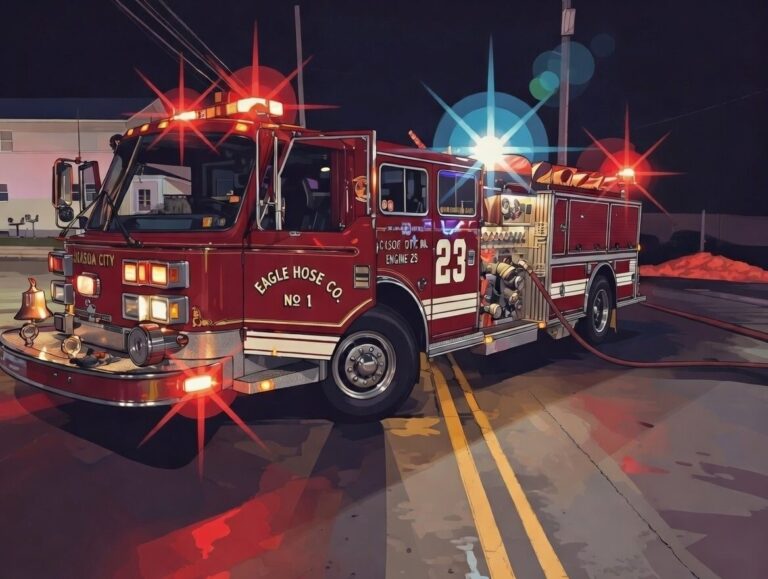
The “Bar & Bird” logo has been around since 1970 as the American LaFrance emblem. The bar with the cross was designed by Ron Tappan in 1965, and it was Ron who added the eagle too.
Almost every organization has an emblem of some sort, and these stem from the days of heraldry. Those were the days when the emblem of a man carried on his shield or helmet, told friend and foe about himself and his heritage. It let the world know his identity, without his ever having to say a word.
A form of cross was adopted by the Fire Service, probably in the mid-1800’s as one of the most distinctive emblems.
Although crosses were used by other religions too, the cross owes its place in heraldry as the accepted symbol of Christianity. In Christian art it represents the passion of Christ and His Church. To firemen, the cross was symbolic of both protecting and being protected. It was accepted by both Roman Catholics and Protestants. Christ and God were to them in their duties, and this idea was important to their survival, and their efforts to help others survive. If their success was not ordained, then the cross, and their religion, was their solace. The cross was often the symbol of a knight, and I doubt that a better description of a fireman could be found.
In heraldry, there are many versions of the cross. What we are primarily interested in, though, is the cross patée, sometimes spelled pattée, with two ts. The second word is pronounced patā (like the stuff made with goose livers.) The cross pattée was the distinguishing badge of the Knights Templar. It is a cross with four limbs which expand to the extremities and whose outer edges are flat.
The Fire Service cross is similar, but with a bulge on the outer edges.
The four limbs of the Maltese cross, the badge of the Knights of Malta, expand and terminate in eight points. These points are said to be symbolic of the Beatitudes. As can be seen, the Maltese cross bears only superficial resemblance to the cross pattée.
Next, we have an addition to the cross pattée and the Fire Service cross. That is the adding of a circle at the center. This does not allow the limbs of the cross to form a “V” where they meet at the center. The rounded projections between the arms, caused by the circle, makes the cross a cross nowy, (pronounced “nou-i” or now-i”.) This makes the whole thing a cross pattée nowy.
The Fire Service cross does not fit exactly into any category that my research material can supply, because of the bumps on the limbs. It may be, as mentioned before, a cross convex, or it may be a cross pattée nowy, nowyed. The term nowyed means the cross has small convex projections, but elsewhere but at the middle.
Finally, we get to the cross that has been used by American LaFrance and its ancestors since 1891. This cross is a cross pattée nowy, and became the Company’s emblem when Button, Silby, Ahrens and Clapp & Jones joined to form the American Fire Engine Company. As can be seen in the 1892 version, each arm symbolizes one of the four founding companies, with the circle bringing them together as the American Fire Engine Company.
Various forms of this emblem have been used over the years, although it did disappear occasionally. Best know to most of us is what is fondly know as the “bar and the bird.” The cross is ignored in the terms, but it is still there.
I realize that you are still going to call it a Maltese cross, but now you have a bit of knowledge to confound your friends.
John M. Peckham